
Published service standard
The refrigerant handling standard behind Burlingame Sub-Zero service
Refrigerant work is the one part of a Sub-Zero visit a Burlingame homeowner cannot watch and judge. So this shop publishes the procedure instead: seven numbered clauses covering recovery before the circuit is opened, a strict no-venting rule, leak repair before any recharge, weighed charges and a written record left in the kitchen. The technicians who carry it out hold EPA Section 608 Universal certification, the individual federal credential for refrigerant work.
Standard statement
No technician working under the Burlingame Sub-Zero Repair name opens, charges or disposes of a refrigerant circuit except by the numbered clauses below — and every clause is written so the homeowner standing in the kitchen can verify it.
This document is the workbench companion to the independent service disclaimer: that page states what the company does and does not claim; this one states how the most regulated part of the work is actually performed.
Published service standard
The standard, clause by clause
These clauses are not marketing copy rewritten for the web. They are the working rules for any Burlingame visit where a Sub-Zero sealed system might be opened, in the order they apply on site.
-
Read the plate before touching the circuit
Every refrigerant decision starts at the unit's serial and rating plate, which lists the refrigerant type and factory charge for that exact build. Sub-Zero's published guidance frames the eras: models made before 1994 carried R-12, products from 1994 forward use R-134a apart from certain PRO models, and refrigeration introduced after January 2021 runs on R-600a. Guessing the refrigerant from a unit's apparent age is how the wrong cylinder ends up on a truck, so the plate is confirmed the same way the model-number guide treats part lookups — photographed and matched, never assumed.
-
Recover before the system is opened
No tubing cutter, piercing valve or brazing torch touches a sealed system until the existing charge has been pulled into a recovery cylinder with dedicated recovery equipment. Section 608 of the Clean Air Act and the refrigerant rules at 40 CFR Part 82, Subpart F exist precisely because this step happens out of the customer's sight. The standard makes recovery the first physical act of every sealed-system repair — including units headed for disposal, which lose their charge to a cylinder, not to the driveway.
-
Never vent — even where the rule would let us
Knowingly releasing refrigerants such as R-134a while servicing or disposing of an appliance is a federal violation, and this clause treats that line as absolute. EPA does exempt isobutane (R-600a) in household refrigerators from the venting prohibition, but the clause does not loosen for it: R-600a is flammable, so it is recovered and handled with hydrocarbon-rated equipment and flame-aware work practices regardless. The only releases tolerated are the trace de minimis amounts that escape during a good-faith recovery.
-
Repair the leak before any recharge
A low charge is a symptom, not a service. If a system lost refrigerant, the leak is located — electronic detector, nitrogen pressure test, or both — and repaired before new refrigerant goes in. Top-off-and-leave visits are prohibited under this standard because they waste regulated refrigerant, mask the underlying fault and put the warm-compartment call straight back on the calendar. If a homeowner declines the leak repair, that decision is recorded and the recharge is declined with it.
-
Weigh in, weigh out
Recovered refrigerant crosses a charging scale and the weight is written down; the replacement charge is weighed in against the figure on the serial plate. Charging by feel, by frost line or by clock time has no place under this standard. The two weights become part of the homeowner's record, so a future technician — ours or anyone else's — inherits real numbers instead of folklore about what the unit "usually takes."
-
Stage the kitchen before the equipment
Most Burlingame Sub-Zeros live inside panel-ready millwork in Easton Addition, Burlingame Hills and Mills Estate kitchens, which puts recovery hoses, nitrogen bottles and sometimes a brazing flame inches from custom cabinetry. This clause borrows its discipline from the cabinet panel protection procedure: floor and panel protection goes down first, heat shielding is placed before any torch is lit near wood, and clearance is confirmed before the unit moves. Sloppy refrigerant work in a built-in kitchen risks the cabinetry as much as the appliance.
-
Only certified hands, and proof on request
Every technician who opens a refrigerant circuit under this standard holds EPA Section 608 certification at the Universal level — the individual federal credential covering all three equipment types, earned through proctored exams administered by an EPA-approved certifying organization. Household refrigerators and freezers are Type I small appliances under EPA's definitions, each shipping with a factory charge of five pounds or under, so Universal more than covers Sub-Zero work. The credential belongs to the person, not the company, it does not expire, and the wallet card is shown whenever a homeowner asks.
Visible table
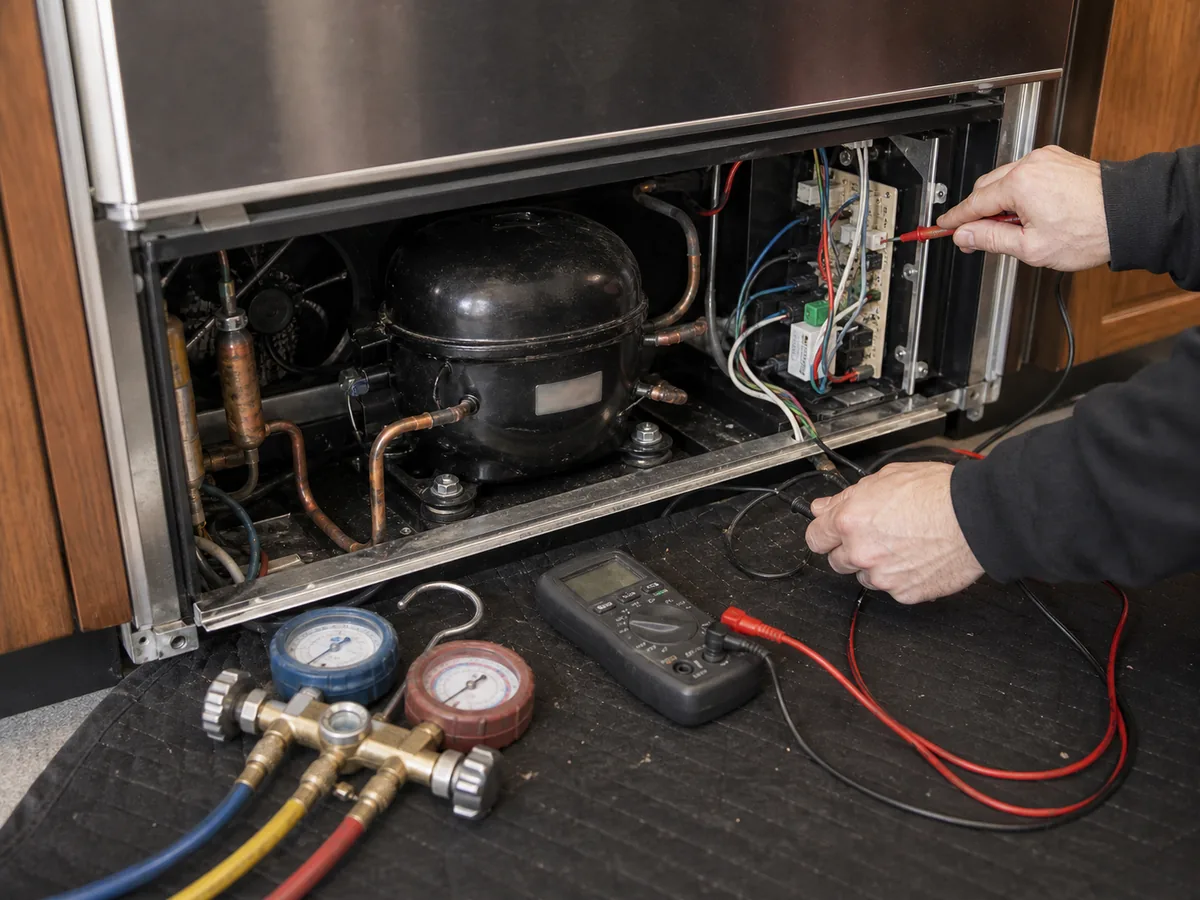
Recovery equipment the standard requires on site
Clauses are only as real as the tools that execute them. A sealed-system visit under this standard arrives with the equipment below; if a required item is missing, the circuit is not opened that day.
| Equipment | What the standard uses it for |
|---|---|
| Recovery machine | pulls the charge out of the sealed system before any joint is opened (clause 2) |
| Recovery cylinders | hold recovered refrigerant for recycling or certified reclamation — nothing is released on site (clause 3) |
| Charging scale | weigh-out of the recovered charge and weigh-in of the new charge against the serial-plate figure (clause 5) |
| Manifold gauges and temperature probes | pressure and temperature evidence before and after the repair, tied to the visible record (clause 7) |
| Nitrogen kit | pressure-testing the repaired joint and displacing oxygen while brazing near cabinetry (clauses 4 and 6) |
| Vacuum pump with micron gauge | deep evacuation verified by measurement, not by elapsed time (clause 4) |
| Electronic leak detector | locating the actual leak before clause 4 permits any recharge |
| Hydrocarbon-rated tools | safe recovery and handling on flammable R-600a units such as newer PRO and post-2021 models (clause 3) |
Refrigerant for stationary equipment is legally sold only to Section 608 certified technicians — one more reason uncertified sealed-system work should raise questions.
What you receive after the visit
Clause seven only matters if the paper actually reaches you. After any visit that opens the refrigerant circuit, the written record left with the homeowner includes:
- The refrigerant type and factory charge as read from your unit's serial plate, not from a generic lookup table.
- The recovered weight and the new charge weight from the scale — the clause-five weigh-in and weigh-out figures.
- The leak location and the repair performed, or the written note that a recharge was declined under clause four.
- The vacuum level reached before recharge, recorded from the micron gauge rather than estimated by time on the pump.
- Fresh-food and freezer temperatures at verification, documented the way the sealed-system evidence page recommends.
- Part numbers for anything replaced; factory-authorized Sub-Zero OEM parts are used when replacement parts are required.
Keep the record with the appliance. If the unit is serviced again, sold with the house or weighed on the repair-versus-replace question, those numbers are the difference between evidence and guesswork.
Published service standard
Why publish an internal standard at all
The steps that decide whether a sealed-system repair was done properly all happen out of sight — inside the machine compartment, at the recovery cylinder, on the scale. A homeowner in an Easton Addition kitchen has no practical way to audit them in the moment. Publishing the clauses converts those invisible steps into commitments that can be quoted back, sentence by sentence, while the work is happening.
It also completes an argument this site already makes. The main repair page holds that estimates should follow evidence, and the sealed-system page holds that compressor quotes need proof before approval. This page covers the remaining gap: once the diagnosis is real, the repair itself should run on written procedure rather than habit — and the procedure should be public enough that any Burlingame homeowner can check the visit against it.
Visible FAQ
Questions Burlingame owners ask about the standard
Why would a repair shop publish its internal refrigerant standard?
Because refrigerant work is the least visible part of a Sub-Zero visit. A homeowner can watch a gasket change, but nobody can see whether refrigerant was recovered or released at the curb. Publishing the numbered clauses lets a Burlingame homeowner hold the visit to a written procedure, the same way the service disclaimer publishes what the company does and does not claim.
What does clause two — recover before opening — commit the technician to?
No brazing torch, tubing cutter or piercing tool touches the sealed system until the charge has been pulled into a recovery cylinder with dedicated recovery equipment. Federal law prohibits knowingly venting refrigerants such as R-134a during service or disposal, and the standard treats recovery as the first physical step of the repair, not an option.
Is the EPA credential behind this standard a company certificate?
No. A Section 608 certificate carries a person's name, never a company's — EPA issues the credential to individual technicians only. The technicians who perform sealed-system work under this standard hold the Universal level of EPA Section 608 certification, earned through proctored exams from an EPA-approved certifying organization, and the credential does not expire.
Will you just add refrigerant to my Sub-Zero without fixing the leak?
Not under this standard. A low charge means refrigerant left the circuit somewhere, and clause four requires the leak to be located and repaired — or the recharge declined in writing — before new refrigerant goes in. Topping off a leaking system wastes refrigerant, hides the fault and usually brings the warm-compartment symptom back.
Which refrigerants does the standard cover in Burlingame kitchens?
All of them. Clause one is written around Sub-Zero's three refrigerant eras: models built before 1994 used R-12, products from 1994 forward use R-134a apart from certain PRO models, and new refrigeration products introduced after January 2021 use R-600a. The serial plate on your unit lists the exact refrigerant and charge, which is why clause one starts at the plate rather than at a gauge.
Is venting R-600a from a household refrigerator actually illegal?
No — the federal venting prohibition stops short of isobutane in a home refrigerator — an exemption EPA wrote deliberately. The standard does not loosen for it anyway: R-600a is flammable, so it is still recovered and handled with hydrocarbon-rated equipment and flame-aware work practices, especially inside a panel-ready Burlingame kitchen.
How do I confirm the person opening my sealed system is certified?
Have the technician produce the Section 608 wallet card before any recovery hose is connected. The card reads like a three-line record for your job file — the person who earned the credential, the level granted, and the EPA-approved organization that administered the exam. Certifying bodies such as ESCO Institute also offer online verification lookups. Asking is normal, and the standard instructs technicians to show the card on request.
Next step
Schedule Burlingame Sub-Zero service
Call or book online with the model number, serial tag photo, current fresh-food and freezer temperatures, and a quick cabinet photo. Same-day routing is available when the Peninsula route, access and required parts allow.
If the visit involves the sealed system, the refrigerant handling standard on this page governs the work from recovery to the written record — and you are welcome to ask for the Section 608 card before anything is opened.
Public contact links
Burlingame Sub-Zero Repair | 840 Hinckley Road, Burlingame, CA 94010 | (650) 668-4599