Skip to content
Burlingame Sub-Zero repair logo Burlingame Built-In RepairSub-Zero service guidance in Burlingame
Google reviews4.9 ★ rated by Burlingame homeowners

Not-cooling hub

Sub Zero Not Cooling Burlingame Built Ins

Last updated 2026-06-06

When a Burlingame built-in Sub-Zero is not cooling, diagnose the installed system first: airflow, door seal, fan, sensors, defrost and cabinet ventilation can all mimic sealed-system failure. Record the fresh-food temperature, freezer temperature, alarm message, frost pattern and whether the lower grille area feels unusually hot before approving a compressor or control-board quote.

Fresh-food warmBoth sections warmFrost patternCabinet ventilationNo reset guessing
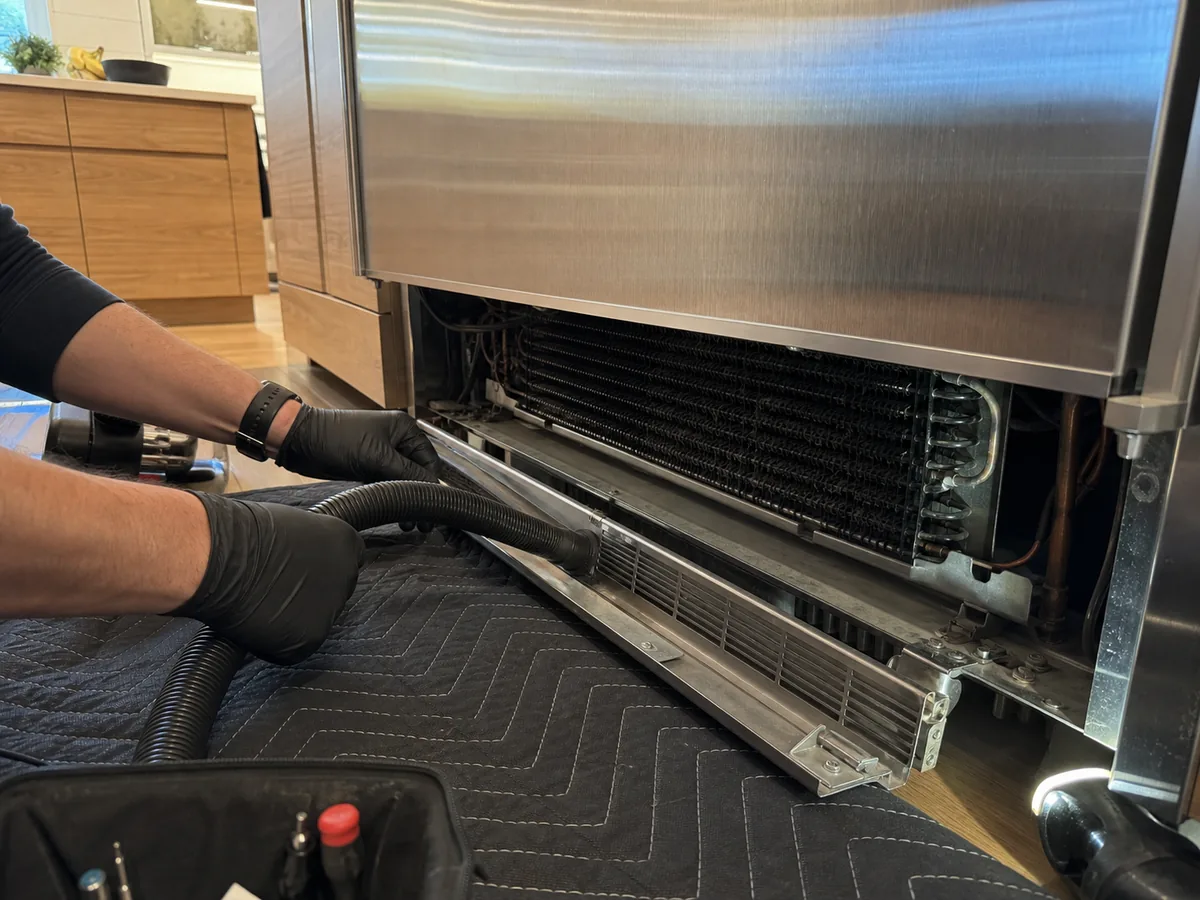
Built-in Sub-Zero refrigerator with the lower grille open for condenser access
Illustrative diagnostic image: condenser access and cabinet airflow are documented before a major cooling quote.

Key facts

  • Sub-Zero not cooling in Burlingame should be sorted by pattern: one section warm, both sections warm, frost wall, fan noise, alarm or hot lower grille.
  • Cabinet ventilation and door contact are first checks on panel-ready built-ins.
  • Do not repeatedly unplug or reset before documenting temperatures and alarms.

Burlingame Sub-Zero quick facts

  • Sub-Zero targets 38°F fresh / 0°F freezer; if the fresh side climbs past ~42°F while the freezer is fine, suspect airflow, a door gasket or the evaporator fan first.
  • Near Burlingame's Bayfront, fog and salt air mat the condenser coil with dust — a common, lower-cost cause of weak cooling before the sealed system is ever involved.

At a glance

What a warm Sub-Zero can cost in Burlingame

Likely causeWhat's checkedPrice rangeTimeframe
Condenser coil fouled (fog/dust)Clean plus airflow check$195–$3451 visit
Evaporator fan motorMotor plus airflow$345–$6951 visit
Door gasket leakGasket plus alignment$345–$6401 visit
Temperature sensorSensor plus verification$235–$4851 visit
Sealed system / compressorDiagnosis plus EPA refrigerant$1,350–$3,200+1–2 visits

A warm compartment is not automatically a compressor; airflow, seals and the coil are ruled out first.

Step by step

How to diagnose a Sub-Zero that is not cooling

  1. Confirm the basics. Check that the unit has power and the door is closing fully.
  2. Record temperatures. Read fresh-food and freezer temperatures with a separate thermometer.
  3. Feel the grille airflow. Weak or hot air at the lower grille points to the condenser.
  4. Inspect the coil. Look behind the lower grille for fog-driven dust and lint on the condenser.
  5. Check the gasket. Inspect the door seal for gaps or edge condensation.
  6. Preserve evidence. Note the frost pattern and avoid repeated unplugging so the fault stays diagnosable.

Customer reviews

What Burlingame homeowners say

Burlingame Built-In Repair is rated 4.9 out of 5 by local Sub-Zero owners. Here is a sample of recent feedback from homes across 94010 and 94011.

Burlingame service area: 94010 and 94011. Visits by appointment.

Kevin D. — Easton Addition

★★★★★ “Our Sub-Zero was warm and I feared the worst. It turned out to be airflow and a fan, not the compressor. They saved us a huge bill.”

Michelle A. — Mills Estate

★★★★★ “Came the same day my fridge stopped cooling, moved my food to the freezer side, and had it back to temperature quickly.”

Robert C. — Burlingables

★★★★★ “They checked the seals, condenser and sensors methodically before quoting. The fresh-food side is holding perfectly now.”

At a glance

Symptom, likely path and first test

What homeowner seesWhat it often meansFirst useful checkWhen to call quickly
Fresh-food warm, freezer coldairflow, fan, thermistor, defrost or gasketrecord both temperatures and listen for fanfood above safe range
Both sections warmpower, condenser, control or sealed systemcheck power, settings, doors and lower grille heatsame day if food is warming
Frost line at doorgasket, hinge or panel alignmentphoto full door and frost linemoisture reaches floor or cabinet
Back-wall frostdefrost, airflow or door leakphotograph before defrostingfan stops or temperature rises
Alarm after resetsensor, control or true temperature issuephotograph alarm before resetalarm returns or cabinet warms

This table ranks first checks; it does not diagnose a part without on-site evidence.

At a glance

Cabinet ventilation clues

ClueWhy it mattersEvidence photo
Hot lower grille areacondenser heat may be trappedlower grille and toe-kick
Rug or stored items near grilleair intake may be restrictedfloor and grille clearance
Recent remodel or panel changereveal or heat escape may have changedfull cabinet opening
Dust or salt-air filmcondenser efficiency can dropcoil or grille area
Door needs push to closewarm air may enter repeatedlydoor reveal and gasket edge

Poor ventilation can mimic a deeper failure and should be corrected before major work is quoted.

At a glance

What not to reset or unplug

ActionWhy it can hurt diagnosisBetter step
Repeated power cyclingerases alarm timingphotograph display first
Chipping frostcan damage liner or coilphotograph frost pattern
Clearing alarms immediatelyloses message and timingrecord code and temperature
Loading warm grocerieschanges recovery patternwait until diagnosis if possible
Forcing a panel-ready doorcan worsen alignmentdocument reveal and gasket

Food safety comes first; preserve evidence only when it is safe to do so.

Not-cooling hub

What this usually means

Fresh-food warm while the freezer still holds often points toward airflow, evaporator fan behavior, thermistor input, defrost conditions or gasket leakage. Both sections rising can broaden the path to power, condenser airflow, control behavior or sealed-system evidence. A frost wall suggests defrost or airflow. A frost line at the door suggests warm-air entry.

A built-in Sub-Zero refrigerator is also affected by the cabinet that surrounds it. A blocked lower grille, tight toe-kick, rug, remodel panel or trapped hot air can keep the machine from rejecting heat. That condition can make a healthy sealed system look weak until airflow is corrected and recovery is observed.

Not-cooling hub

What to have ready before calling or booking online

Have the model and serial number, fresh-food temperature, freezer temperature, alarm photo and one wide cabinet photo. If frost is visible, photograph the pattern without chipping it away. If the lower grille area is hot or blocked, photograph that area too. Mention whether doors were left open, groceries were loaded or power changed recently.

Do not repeatedly power-cycle the unit while waiting for service unless food safety requires immediate action. Repeated resets can erase alarm timing, fan behavior and frost evidence. Move food first if temperatures are unsafe, then preserve the diagnostic pattern.

Not-cooling hub

Burlingame-specific clues

Fog and humidity can expose weak gasket contact as condensation, frost beads or a wet corner. Salt-air residue and fine dust can collect on the condenser and raise run time before the owner notices a temperature rise. Older Easton Addition cabinets can trap heat around lower grilles; Hillside homes can make same-day routing more dependent on model proof.

Mills Estate panel-ready installations often have heavier doors and wide reveals, so gasket contact and hinge behavior deserve a check before a sealed-system conclusion. Burlingame Avenue condos can add access windows, which makes photo triage useful before a route is committed.

Not-cooling hub

When not to guess

Do not assume compressor failure because both compartments are warm. Do not assume a board failure because an alarm appeared. Do not chip frost with tools, overload the refrigerator with warm food or tape the door closed against a misaligned panel. Each action can create a new symptom or hide the old one.

A sealed-system path should follow evidence: abnormal frost pattern, poor recovery after airflow correction, compressor electrical readings, pressure checks when appropriate and leak indicators. If those pieces are not present, the quote should stay diagnostic rather than jumping to a major repair.

Not-cooling hub

Food safety and timing

If fresh-food temperatures are above safe range or freezer food is softening, move food before service planning. Write down the time and temperature. A refrigerator that is stable but several degrees warm is different from one rising quickly after an alarm. That urgency affects whether the next step is an immediate diagnosis, a planned visit or a repair-versus-replace conversation.

Temperature direction matters more than one display reading. A unit that improves after airflow correction is on a different path than a unit that runs continuously with no pull-down. That is why the first visit should document temperatures and what changed after each test.

Next step

Book your Burlingame Sub-Zero service

Two easy ways to reach Burlingame Built-In Repair: call us directly or book your appointment online. Have your model and serial number handy if you can, so we can plan parts and cabinet access before the visit.

We serve Burlingame 94010 and 94011 and the nearby Peninsula by appointment, with careful, cabinet-safe service for built-in Sub-Zero refrigerators.

Contact us

Phone lines and online booking are open for Burlingame Sub-Zero appointments.

FAQ

Sub-Zero questions from Burlingame homes

Why is my fresh-food side warm while the freezer is still cold?

That pattern often points to airflow, fan, thermistor, defrost or gasket behavior rather than immediate compressor failure. Record both temperatures and note fan sound, frost location and door contact. The first useful evidence is the pattern, not a part name.

What if both compartments are warm?

Both sections warm can involve power, controls, condenser airflow, fans or sealed-system evidence. Check that doors are closed, settings are normal and the lower grille is not blocked. If food is warming quickly, move it first and request diagnosis quickly.

Should I unplug a Sub-Zero that is not cooling?

Do not repeatedly unplug it to force a reset unless food safety or an electrical concern requires it. A reset can erase alarm timing and frost evidence. Photograph the display, write down both temperatures and note noises before changing the unit state.

Can poor cabinet ventilation make a Sub-Zero not cool?

Yes. A built-in refrigerator needs a heat escape path. Blocked grilles, tight toe-kicks, remodel changes or trapped warm air can increase run time and temperatures. Cabinet ventilation should be checked before a sealed-system quote is treated as the answer.

Does frost mean the sealed system failed?

Not by itself. Frost location matters. A door-edge frost line can be gasket or alignment. A back-wall pattern can be defrost, airflow or door leakage. Sealed-system evidence needs a broader test sequence, not just one visible frost condition.

How quickly should I call?

Call quickly when food is above safe range, both compartments are rising, an alarm returns after reset, frost grows rapidly or water threatens flooring or cabinetry. If the unit is only slightly warm and stable, record temperatures and preserve evidence before scheduling.

What should I photograph before calling or booking online service?

Photograph the model and serial number, both temperatures, any alarm, the lower grille and the full cabinet opening. Add frost, water or gasket close-ups when visible. Those photos help separate airflow, door contact, water and sealed-system paths before the visit.

Can a compressor be diagnosed from the symptom alone?

No. A compressor or sealed-system decision needs evidence such as frost pattern, airflow status, electrical readings, pressures when appropriate and leak indicators. A symptom alone is enough to start diagnosis, not enough to approve major sealed-system work.

Does Burlingame's coastal fog make Sub-Zero cooling problems worse?

Yes. Marine-layer humidity and salt air accelerate condenser-coil fouling and gasket condensation. East of Highway 101 near the Bayfront we often find a dust-matted coil behind the lower grille as the real cause of a warm compartment, fixed for $195–$345 rather than a major repair.