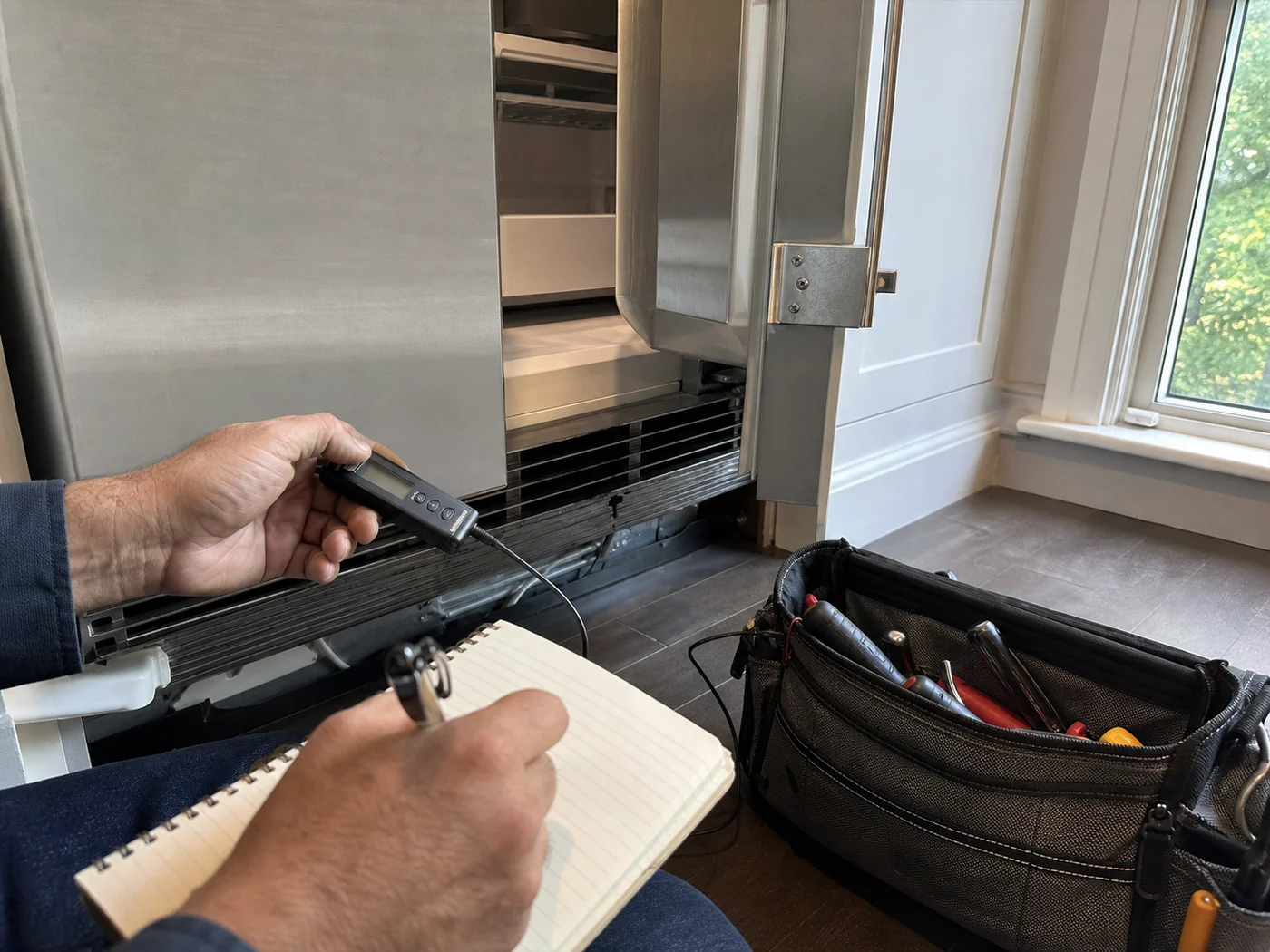
Carlos D., Oak Grove Manor
Warm fresh-food side in a panel-ready unit turned out to be trapped heat at the lower grille. He logged temperatures, photographed the condenser and corrected the airflow rather than condemning the compressor.
Diagnostic examples
A useful Burlingame Sub-Zero case portfolio shows the installation, symptom, evidence, cabinet protection and outcome without publishing private client details. These diagnostic summaries explain the model family, first test, access risk, repair decision and verification while protecting addresses, faces, invoices and personal information.
Review trust
The wider appliance repair service network is backed by 700+ customer reviews across platforms with a 4.9 average rating. Burlingame customers most often mention careful cabinet protection, clear diagnosis, temperature recovery and estimate clarity.
Burlingame Sub-Zero Repair, 840 Hinckley Road, Burlingame, CA 94010. Phone: (650) 668-4599.
Warm fresh-food side in a panel-ready unit turned out to be trapped heat at the lower grille. He logged temperatures, photographed the condenser and corrected the airflow rather than condemning the compressor.
After a remodel a toe-kick change had choked the ventilation and triggered an alarm. He caught it from the grille clearance and fixed it in place, no expensive pull-out needed.
Hollow ice cubes after a filter change traced back to a shutoff hidden behind the panel. A water-volume test pinpointed it and the ice maker came back to normal.
Visible table
| Scenario | Cabinet issue | Diagnostic proof | Outcome category |
|---|---|---|---|
| Fresh-food warm in panel-ready unit | lower grille heat trapped | temperature log and condenser photo | airflow correction |
| Frost line at custom panel door | door reveal pulling seal | full door photo and light test | gasket and alignment path |
| Hollow cubes after filter change | shutoff hidden behind panel | cube photo and water-volume test | water-side diagnosis |
| Alarm after remodel work | toe-kick change blocked ventilation | alarm photo and grille clearance | service in place |
| Slow pull-down after cleaning | pull-out needed for deeper test | frost pattern and electrical readings | sealed-system review |
Examples are diagnostic summaries; customer reviews are shown in the review section.
Visible table
| Photo type | Caption should name | Avoid |
|---|---|---|
| Model tag | model/serial proof used for lookup | full serial if privacy policy requires redaction |
| Cabinet opening | panel fit and access condition | address, faces, family items |
| Frost or gasket | location and first test | dramatic claims without result |
| Ice cubes | shape and water/temperature path | guessing module failure |
| Floor protection | pre-movement condition | blaming without before photo |
Remove private details before publishing any evidence photo.
Visible table
| Category | Use when | Verification |
|---|---|---|
| Repaired in place | part or adjustment did not need pull-out | symptom-specific post-check |
| Protected pull-out | rear or lower access required movement | floor, panel and water-line check |
| Part ordered | model proof changed the part plan | tag photo and part match |
| Airflow maintenance | heat rejection issue found | temperature direction after cleaning |
| Repair-versus-replace | cost, age or parts changed decision | written evidence summary |
Outcome categories should be supported by the note, not used as marketing claims.
Diagnostic examples
An evidence portfolio is a record of how a built-in Sub-Zero issue was approached. It can show that a warm refrigerator was first checked for airflow, that a gasket complaint included reveal documentation, or that an ice maker call separated water volume from freezer temperature. The value is the repeatable process, not praise.
Each note should avoid client names, exact addresses, faces, license plates, private invoices and anything that exposes a home. Neighborhood-level context is enough: Easton Addition custom panel, Mills Estate wide built-in, Burlingame Avenue condo access or 94010 water-line routing.
Diagnostic examples
Have the same service details ready: model and serial number, two temperatures, wide cabinet photo and close-up symptom photo. If the photo may be used later as anonymized evidence, remove private details and avoid showing family items, faces, mail, artwork labels or readable addresses.
A good diagnostic photo is usually boring: the lower grille, frost line, model tag, cube pattern, alarm display, door reveal or protected floor path. It helps the next homeowner understand the symptom without exposing the current homeowner.
Diagnostic examples
Burlingame cases should explain local variables only when they changed the work. Fog and humidity may make a gasket leak visible. Salt-air film may increase condenser run time. A condo elevator may change scheduling. A remodel panel may change door closure. These details are useful because they connect a symptom to a place without turning the page into doorway text.
The portfolio should not claim that every neighborhood creates the same issue. It should name the condition: tight toe-kick, hidden shutoff, wide panel-ready reveal, sloped access, property-manager window or cabinet ventilation problem.
Diagnostic examples
A case note should stay specific to the service work: symptom, first test, finding, repair path, verification and caveat. Private addresses and identifying photos stay off the public site.
The best case note is modest and specific. If the outcome was only diagnosis or a repair-versus-replace decision, say that. A non-repair decision can still be useful service history.
Diagnostic examples
Use simple outcome categories: repaired in place, protected pull-out required, part ordered after model proof, maintenance and airflow correction, sealed-system evidence confirmed, repair-versus-replace discussion or no fault found after monitoring. These categories keep the page factual.
A case note should include the verification method. For cooling, that may be temperature direction. For ice, fill and harvest behavior. For gasket work, repeated door closure and condensation risk. For water, dry floor and valve behavior.
Next step
Call or book online with the model number, serial tag photo, current fresh-food and freezer temperatures, and a quick cabinet photo. Same-day routing is available when the Peninsula route, access and required parts allow.
For replacement parts, the policy is straightforward: factory-authorized Sub-Zero OEM parts are used when required, and the finding is documented before repair.
Burlingame Sub-Zero Repair | 840 Hinckley Road, Burlingame, CA 94010 | (650) 668-4599
Visible FAQ
Customer reviews describe the homeowner experience. The case portfolio describes the diagnostic work: symptom, evidence, cabinet protection and outcome. Keeping both visible makes the page useful for trust and for repair planning.
Remove names, exact addresses, faces, license plates, invoices, family photos, mail, artwork labels and anything that identifies a specific household. Neighborhood-level context is usually enough when it explains access, humidity, panel or scheduling conditions.
They can show that a tag was used, but the privacy policy should decide whether full serial numbers are redacted. The caption should explain the diagnostic role of model proof, not expose unnecessary identifying information.
Some useful outcomes are diagnostic: sealed-system evidence confirmed, replacement discussion started, part availability changed the plan or no fault was found after monitoring. Honest non-repair notes can be more credible than forcing every case into a success story.
A useful note has a symptom, model family, first test, cabinet condition, finding, outcome and verification method. It avoids generic praise and gives the next homeowner a specific repair pattern to compare.
Only if the technician is a real person with confirmed role and consent. Otherwise use a service-team line and keep the focus on the appliance, model, diagnosis and verification.
Avoid repeating the same paragraph across many pages. Link to the portfolio, then summarize only the relevant fact on symptom pages. Repetition can look like a template footprint and makes the evidence less useful.
It should show visible diagnostic examples, image captions, FAQs, related service pages and a clear contact path. Any structured data should match the visible page text.