The bottle you opened to breathe at room temperature is one thing; the case you've been laying down for a decade is another. When a Sub-Zero wine column stops holding its set point, the collection inside is the thing actually at risk — and unlike a kitchen fridge, the warning signs are subtle until they aren't.
Sub-Zero builds genuine built-in wine storage — integrated and undercounter columns engineered to hold cellar conditions, not just "cold." That precision is the whole point, and it's also where the faults show up. Here's what we find behind a Burlingame wine unit that's drifting.
Dual-zone drift and the sensor behind it
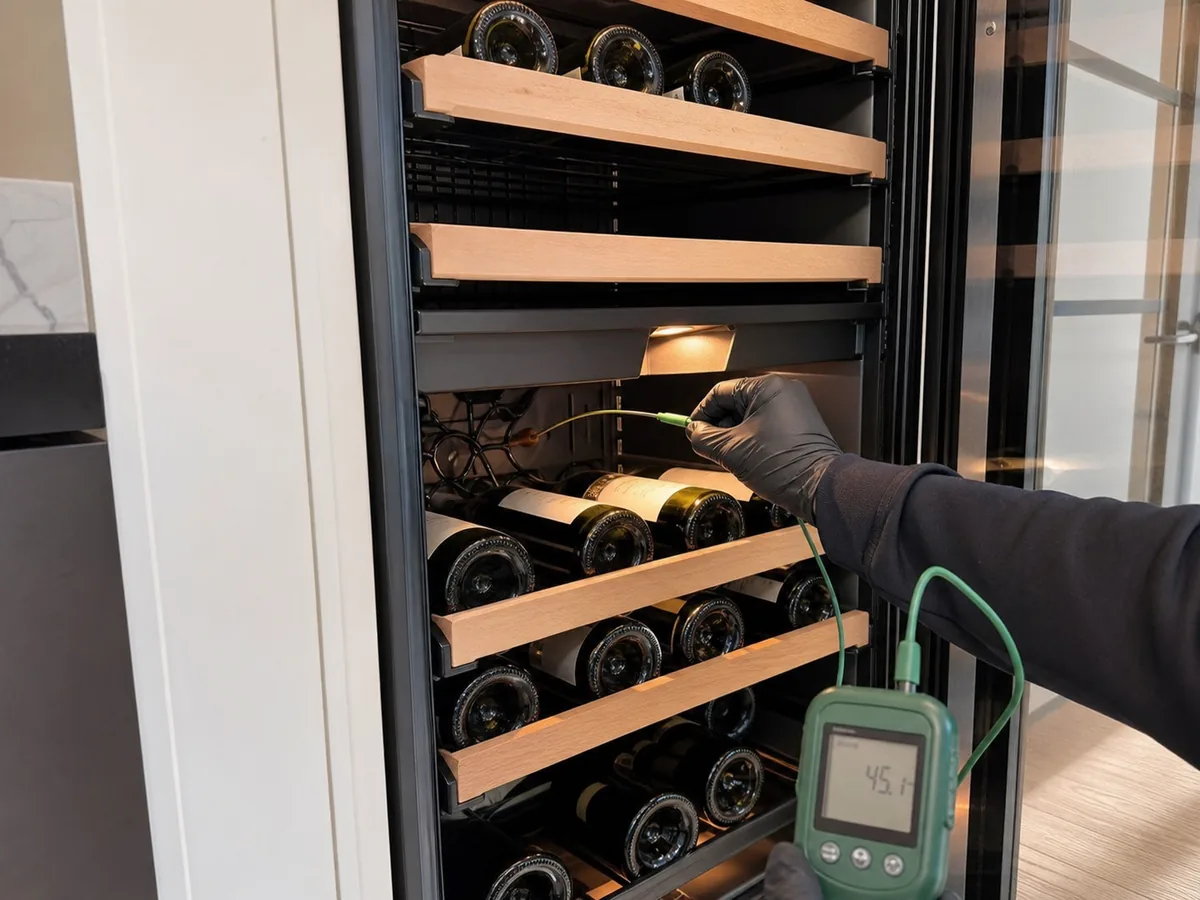
Most Sub-Zero wine units run two independent zones — a cooler bay for whites and sparkling, a warmer bay for reds — each governed by its own thermistor reading a few degrees with real accuracy. When one zone climbs while the other holds, the cabinet itself is usually fine; a single dual-zone sensor has drifted out of calibration and is feeding the control board a false number. The fix is a sensor swap, not a new appliance, and it's one of the more common calls we get on these units. What makes it sneaky is that the display can still show the temperature you asked for while the actual zone sits five or six degrees off — which is why we put a calibrated probe inside the bay rather than trusting the front panel.
The sealed system, airflow, and Burlingame's damp coil problem
A wine column shares the same sealed-system DNA as a Sub-Zero refrigerator — compressor, evaporator, condenser, refrigerant — just tuned to a narrower, warmer band. The most frequent cause of slow, steady warm drift isn't the compressor failing; it's a condenser coil loaded with the fine, moisture-bound dust that Burlingame's marine layer deposits on everything. Under a grey, humid sky the coil films over, can't shed heat, and the unit slowly loses its grip on temperature. Homes near the Bayfront and the lagoon, where the fog carries a trace of salt, see this faster and should plan on a more frequent coil clean. If the coil is clear and the evaporator fan is moving air properly and the unit still can't hold, then we look harder — a refrigerant loss or a tired compressor — and we put gauges on it before quoting anything that size.
Seals, UV glass, and the quiet enemy of vibration
Two things protect what's inside beyond temperature: the door gasket and the tinted, UV-filtering glass. In Burlingame's steady humidity a gasket that sealed cleanly can begin to weep and frost at the corners, letting warm cabinet air leak in and forcing longer run cycles — run a hand along the seal seasonally and watch for a cold, damp line. The UV-glass seal matters too; once it loosens, light and warmth reach the bottles even if the compressor is perfect. The other slow killer is vibration. A compressor mount or a fan that's begun to buzz transmits a fine tremor into the racks, and sustained vibration disturbs sediment and tires a wine over years — so a unit that has gotten noticeably louder is worth a look even when the temperature still reads right. Anchored kitchens up in Burlingame Hills, where older Mediterranean and Spanish-revival homes weren't built around a 24-inch column, are also where we most often find a unit boxed in with too little breathing room at the grille.